




Choosing an order picking ladder supplier involves more than comparing prices and platform heights. The right equipment needs to suit your warehouse layout, picking tasks, floor conditions and workplace safety requirements.
For Australian warehouses and distribution centres, a good purchasing process starts with understanding how workers access stock, how frequently equipment needs to be repositioned and what support is available after delivery.
This guide explains what to assess before requesting a quote, how to compare ladder designs and which questions to ask potential suppliers.
Key Takeaways
- Map picking heights, task frequency and aisle dimensions before comparing products.
- Check the equipment’s load rating and restrictions against the intended task.
- Compare mobility, platform access and stability features with actual warehouse conditions.
- Request applicable standards information, operating instructions and inspection guidance.
- Confirm dimensions, delivery, assembly, warranty and after-sales support before ordering.
1. Assess Your Warehouse's Order Picking Requirements
Start by identifying the work your team performs rather than selecting a ladder based on a headline specification. Consider where stock is stored, how frequently workers need access and whether the same equipment will serve several picking areas.
Identify picking heights and task frequency
Record the shelf heights, required access points and locations workers visit most often. Frequent picking across several bays may require different mobility and manoeuvrability characteristics from occasional access at a fixed location.
A simple task assessment can help you compare options:
Picking situation | Information to record | Question to resolve |
|---|---|---|
Frequent picks across several shelves | Shelf heights and pick frequency | How easily must the ladder be repositioned? |
Access to higher storage levels | Required platform height and clearances | Which configuration suits the task? |
Picking across multiple aisles | Aisle widths, turning spaces and routes | Can the equipment move and park safely? |
Handling bulky or heavy stock | Item dimensions, weight and handling method | Is a separate lifting or handling solution needed? |
Use these measurements when discussing equipment with your supplier. Where access heights or clearances are uncertain, request confirmed product dimensions rather than estimating from photographs.
Check load ratings and item-handling requirements
Consider the worker, clothing or personal equipment, tools and items handled during the task. Check the product’s rated capacity and operating instructions, including any restrictions on carrying, lifting or transferring items.
Weight is only one consideration. Bulky or awkward items may affect how a worker accesses the platform and handles stock safely.
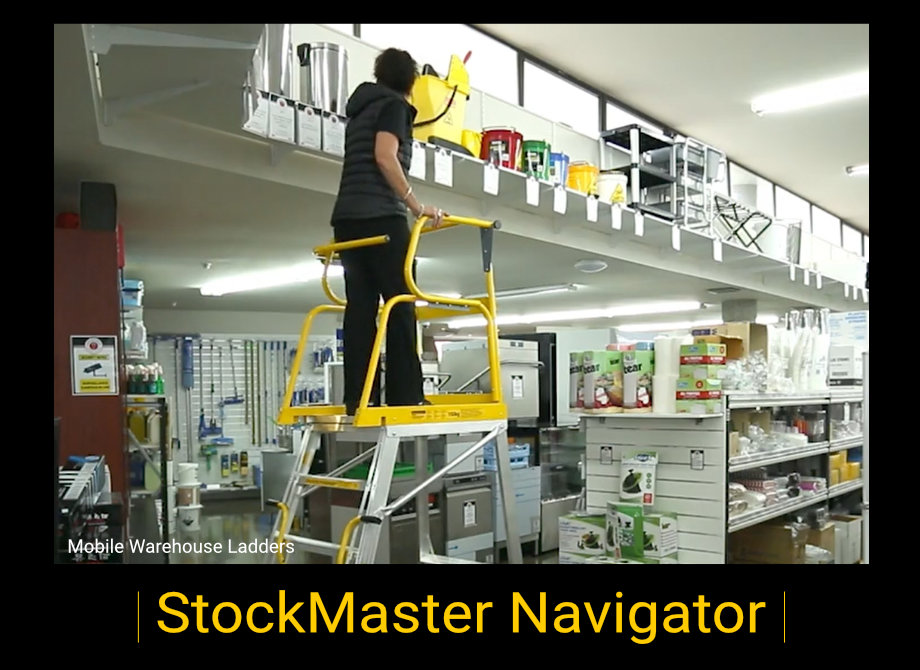
For example, the StockMaster Navigator is designed for warehouse order picking and shelf stocking. Its product guidance specifies lightweight items of up to 5 kg for the general picking application, subject to stated exceptions. Where heavier items need to be raised or positioned, consider whether a dedicated material-handling solution is more appropriate.
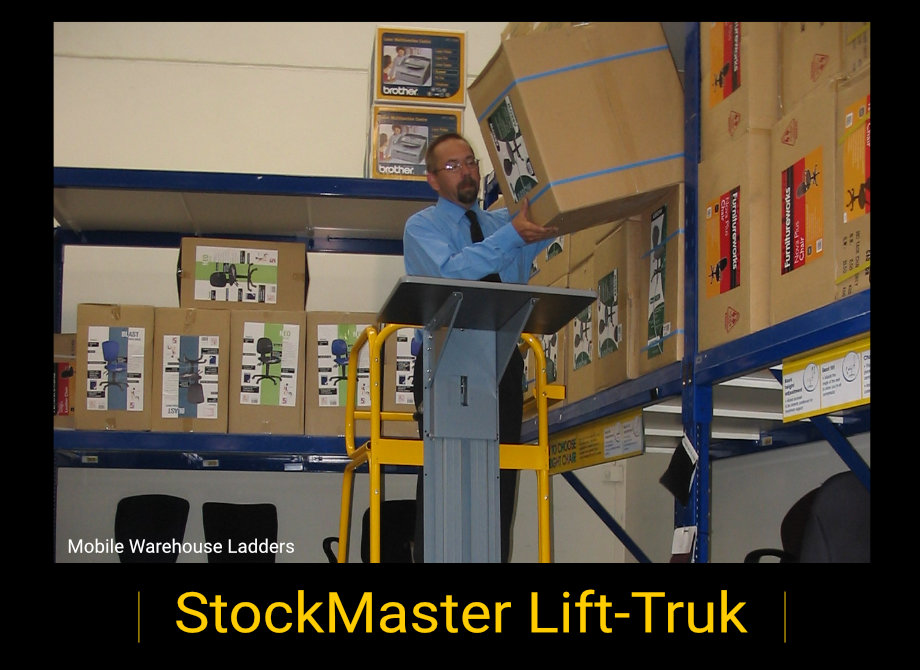
The StockMaster Lift-Truk combines elevated access with a manually operated lifting table rated for loads up to 60 kg. That figure relates to its lifting function; confirm the model’s operating instructions and suitability for the intended task before selecting it.
Assess aisle widths, floors and warehouse traffic
Measure clear aisle widths, doorways, turning points and available parking space. Record floor transitions, slopes, surface conditions and the movement of forklifts or other warehouse equipment.
These factors can influence which ladder design is appropriate. A mobile platform ladder intended for smooth, level warehouse floors may not suit an area with uneven surfaces or restricted manoeuvring space.
Where possible, assess the proposed equipment in the actual work area and consider how it will interact with normal warehouse operations.
2. Compare Order Picking Ladder Designs
Order picking ladders differ in their access arrangements, mobility and suitability for particular environments. Compare the documented capabilities of each design against your task and workplace conditions.
Explore the StockMaster order picking ladder range to compare available solutions.

Choose a ladder suited to the application
A mobile warehouse platform ladder may suit frequent picking between nearby storage locations. Other mobile work platforms may be more appropriate where surfaces are less uniform or equipment needs to move between different work areas.
For example:
- StockMaster Navigator: Designed for warehouse order picking and shelf stocking on suitable, smooth and level surfaces. Its single control provides movement, steering and braking, with the four feet grounded when the ladder is stationary.
- StockMaster Tracker: Uses two large wheels and is designed for a wider range of operating surfaces. It requires adequate space for the operator to steer and is not suitable for confined spaces.
- StockMaster Lift-Truk: Combines a platform with a manually operated lifting table for applications involving stock handling as well as elevated access.
Evaluate platform access and protective features
Check how workers access and leave the platform, where they stand while picking and which safety features are included in the proposed configuration.
Ask whether handrails, guardrails, gates or other accessories are standard or optional. Confirm the precise model and configuration being quoted, and check that the access arrangement suits the location of the stock and the intended work method.
Product features should support your workplace risk controls rather than replace them.
Check movement, braking and stability
For mobile equipment, establish how it moves between picking locations and how it is secured in the working position. Review the manufacturer’s instructions for braking, positioning and any stabilising components.
Floor conditions matter. Navigator, for example, requires a smooth and level operating surface, while Tracker may be suitable for some less uniform surfaces, depending on the operating space and application.
Choose equipment based on its documented operating limits rather than assuming that every mobile ladder is suitable for every warehouse.
3. Check Safety and Compliance Information
Safety information should be part of the purchasing decision from the beginning. Ask suppliers to identify the standards and documentation applicable to the exact model and configuration.
Request applicable standards and product documentation
Ask for the relevant product instructions, load rating, warnings and supporting standards information. Confirm that the documents relate to the model being quoted.
StockMaster provides information on standards and risk assessments, including the Australian manufacturing standard AS 1892.1:2018 for portable metal ladders. Applicable requirements can vary by product, so check the individual product documentation rather than assuming every standard applies to every model.
A product’s conformity to a manufacturing standard does not, by itself, establish that it is suitable for a particular workplace task.
Review operating instructions and inspection guidance
Before purchase, establish what checks, maintenance and operating procedures the manufacturer recommends. Ask how damage or wear should be reported and what should happen if a defect is identified.
Keep the relevant instructions accessible to workers and supervisors. Where inspection intervals or other requirements are unclear, request clarification from the supplier instead of assuming a schedule.
Confirm suitability for your workplace risk controls
Assess the proposed ladder in the context of aisle traffic, pedestrian routes, floor conditions, storage arrangements and the work being performed.
Your workplace risk assessment should consider the actual application and the equipment’s operating instructions. Resolve any concerns with the relevant safety personnel and supplier before introducing the ladder into service.
4. Evaluate Potential Suppliers
A suitable supplier should be able to explain the equipment’s capabilities, provide relevant documentation and help you resolve practical questions before and after purchase.
Look for relevant industry experience
Ask whether the supplier understands warehouse access, order picking, shelf stocking and the constraints of busy storage areas.
A useful supplier discussion should cover the information needed to assess suitability, including platform height, aisle clearances, floor conditions, item handling and repositioning frequency.
The supplier should distinguish between confirmed product specifications and matters that require further assessment.
Compare technical support and documentation
Before requesting a quote, establish whether the supplier can provide:
- Product dimensions and configuration details.
- Load ratings, operating instructions and applicable standards information.
- Inspection, maintenance and spare-parts information.
- A contact for technical questions before and after delivery.
Ask for clarification where documentation is incomplete or a specification is unclear. Written answers make it easier for purchasing and safety teams to evaluate the same information.
Confirm delivery and after-sales support
Check lead times, freight arrangements, assembly requirements and the instructions supplied with the equipment.
StockMaster products use a modular design, and assembly instructions and fasteners are supplied with the relevant kits. Confirm the assembly requirements for the specific model and who will be responsible for completing it.
Also establish how replacement parts, technical questions and warranty enquiries will be handled. For an operation using several ladders, the availability of ongoing product support can be an important consideration alongside the initial purchase price.
5. Review Specifications Before Requesting a Quote
A meaningful quote should identify equipment that suits the intended task and the physical constraints of the site.
Confirm dimensions and working height
Check the overall footprint, platform dimensions, platform height and access clearances. Distinguish platform height from working or reach height, and confirm how the supplier defines each measurement.
Where space is restricted, provide aisle measurements, doorway heights and turning clearances. Request a drawing or technical specification when needed.
Check materials and operating environment
Explain the conditions in which the ladder will be used, including floor surfaces, indoor or outdoor operation and any relevant environmental exposure.
Ask the supplier to confirm whether the selected model is suitable for those conditions. Do not assume that a product intended for warehouse floors will be appropriate for every surface or application.
Clarify options, warranty and lead times
If the standard configuration does not meet your requirements, ask which options are available and whether changes affect dimensions, operating instructions, documentation or warranty terms.
Request the final configuration in writing. Compare warranty conditions, delivery timing and any additional costs before approving the order.
6. Plan Rollout and Ongoing Care
A successful purchase also depends on preparing the workplace and the people who will use the equipment.
Consider a site assessment or product trial
Where dimensions, movement or access remain uncertain, ask whether a site assessment or product trial is available.
Check the proposed equipment’s footprint, movement route, parking location and interaction with normal warehouse traffic. If a trial is not practical, provide accurate measurements and request relevant drawings or specifications.
Train workers on the selected model
Base training on the manufacturer’s instructions and your workplace risk controls. Cover access and exit, positioning, movement, the use of relevant safety features and defect reporting.
Ensure workers and supervisors understand the procedures applicable to the actual equipment delivered.
Establish inspection and maintenance processes
Assign responsibility for inspections, defect reporting and maintenance records. Follow the manufacturer’s guidance and establish how damaged equipment will be taken out of service pending assessment.
Record the model, configuration and relevant product documents so your team can confirm that the equipment in use matches the equipment selected for the task.
Conclusion
Choosing an order picking ladder supplier in Australia starts with understanding your warehouse and the work your team performs. Compare equipment against your picking heights, floor conditions, available space and handling requirements, then verify the relevant specifications and safety documentation.
A supplier who provides clear technical information and practical after-sales support can help you make a better-informed purchasing decision. Before requesting a quote, gather your site measurements, confirm the required configuration and identify any questions that need to be resolved.
To discuss your application, contact StockMaster for product information and assistance in identifying suitable access equipment.
Frequently Asked Questions
What should you tell an order picking ladder supplier before requesting a quote?
Provide the required access heights, picking frequency, aisle dimensions, floor conditions, item-handling requirements and delivery location. Include relevant workplace controls and any configuration requirements.
How do you determine the required ladder capacity?
Consider the intended load and the manufacturer’s stated rating and restrictions. Confirm how the rating applies to the specific model and intended use, including any limits on carrying or handling items.
Is a mobile ladder suitable for every warehouse?
No. Suitability depends on the floor, available space, turning clearances, traffic and intended work method. Check the operating requirements of the specific model.
What is the difference between platform height and working height?
Platform height is the height of the standing platform. Working or reach height describes the height a worker can access and may be defined differently by different suppliers. Confirm the measurements used in the product specifications.
Which safety documents should you request?
Ask for the operating instructions, load rating, applicable standards information, warnings and inspection guidance for the exact model and configuration. Review these alongside your workplace risk assessment.
Should you arrange a site assessment or product trial?
Consider one if fit, movement or access remains uncertain. If neither is available, supply accurate measurements and request the relevant technical drawings and specifications.
What should you plan after delivery?
Arrange any required assembly, worker training, access to operating instructions, inspection responsibilities, defect reporting and maintenance records. Check that the delivered equipment matches the agreed configuration.